Leave Your Message
Choosing the right Conveyor Equipment can affect product flow, labor demands, and daily maintenance. A line moving sealed cartons needs different support from one carrying loose ingredients or heavy components. Even a short transfer point can create bottlenecks when its speed, width, or height does not match the surrounding process.
Start by looking closely at the material and the route. Note each item’s weight, dimensions, surface, and behavior at turns or inclines. Measure available floor space, transfer heights, and the distance between workstations. Then consider throughput, operating hours, dust, moisture, and cleaning needs. A belt conveyor may suit continuous movement, while powered rollers can handle compatible cartons efficiently. Small details matter. A rough underside, for example, may wear a belt faster than expected.
This guide explains how to compare conveyor types, estimate capacity, and assess controls, installation, and maintenance requirements. It also highlights questions to ask suppliers, such as how components are serviced and whether the system can connect with existing equipment. There is no universally best conveyor. A low purchase price may look appealing, but energy use, downtime, and replacement parts deserve equal attention. Some choices still involve trade-offs. Reviewing real operating conditions—and revisiting assumptions before ordering—can help businesses choose a practical system rather than one that only looks right on paper.
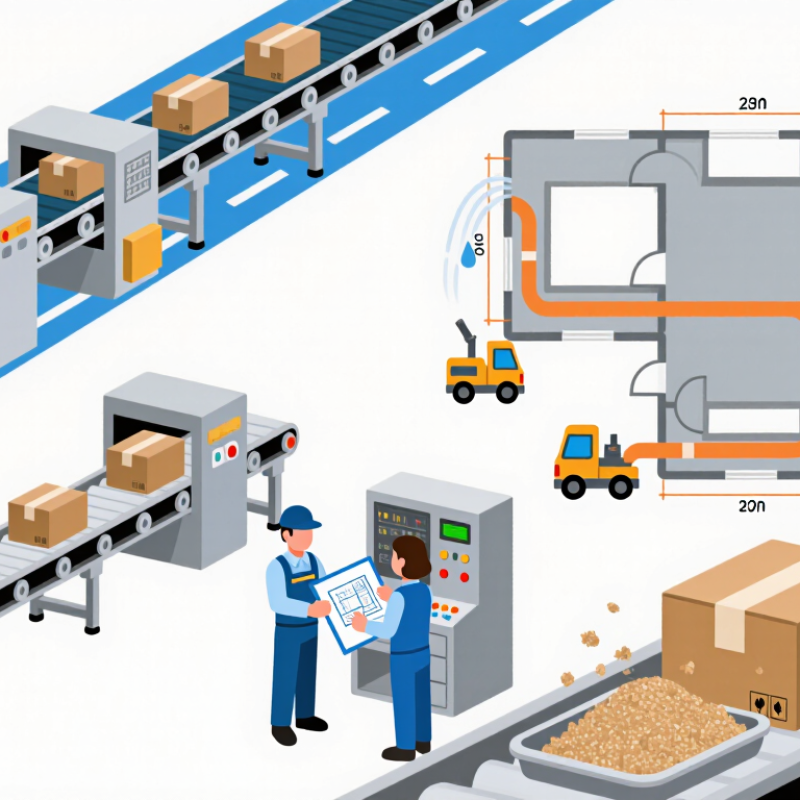
Choosing conveyor equipment starts with the work, not a product list. Record each item’s dimensions, weight, packaging, fragility, and orientation. Measure average and peak hourly throughput; daily totals can hide sharp surges. A line moving 600 cartons an hour may still jam when a batch arrives at once. Note shift patterns, changeovers, cleaning routines, floor slopes, and where workers lift or turn loads. Small details matter.
MHI’s 2024 Annual Industry Report found that 55% of surveyed supply-chain professionals planned to increase technology investment over the next five years. Before adding automation, define what the conveyor must connect to: scanners, packing stations, storage, or existing controls. Specify load limits, transfer points, required speeds, and available floor space. Also review pinch points and repeated lifting. The U.S. Bureau of Labor Statistics reported 2.4 recordable injury and illness cases per 100 full-time-equivalent workers in private industry in 2023. That figure is not conveyor-specific, but it makes task-level safety checks worth including.
A spreadsheet can miss the awkward carton that catches at a transfer or the wet patch near a washdown area. Walk the route during a busy shift. Measure it. Ask operators where delays occur, then verify their answers against actual flow data. I would not treat one peak day as the whole story; seasonal demand and product changes can make an otherwise sound specification feel wrong.
Start by documenting the product, required flow, route, operating environment, and handling constraints. Use the examples below as a planning guide; confirm capacity and equipment specifications with a qualified conveyor designer.
| Business Need | Material and Handling Requirements | Typical Flow or Route | Conveyor Type to Evaluate | Key Checks Before Selection |
|---|---|---|---|---|
| Move individual cartons between packing and shipping | Stable, closed cartons; mixed sizes and weights; products should remain upright | Short-to-medium distances, often with straight sections and occasional curves | Belt conveyor or powered roller conveyor | Carton dimensions and weight range; required spacing; curve radius; accumulation needs; belt or roller surface compatibility |
| Transport uniform boxes through a high-volume distribution area | Regularly sized cartons; frequent starts and stops; controlled merging or diverting may be needed | Multiple lines feeding sorting, packing, or dispatch points | Powered roller conveyor, with compatible merge and sortation equipment where required | Peak cartons per hour; minimum and maximum carton size; zone control; sensor placement; safe access for clearing jams |
| Move loose, dry bulk material | Granular or lumpy material such as grain, aggregate, or pellets; dust and spillage may be concerns | Continuous flow across longer routes, including possible elevation changes | Trough belt conveyor or screw conveyor, depending on route and material | Bulk density; particle size; moisture and abrasiveness; required mass flow; enclosure and dust-control needs; incline angle |
| Transfer hot, sharp, or abrasive parts | Durable components that may have rough edges or elevated temperatures | Short, controlled transfers between production operations | Steel belt conveyor or heavy-duty chain conveyor | Part temperature and impact load; edge and surface characteristics; belt or chain material; guarding; maintenance access |
| Handle products in a washdown or wet-processing area | Food or other products exposed to water, cleaning chemicals, or frequent sanitation | Production lines requiring routine cleaning and drainage | Washdown-rated belt conveyor or modular plastic belt conveyor | Cleanability; drainage; chemical compatibility; corrosion resistance; hygienic design requirements; local food-safety rules |
| Move small items or components between workstations | Lightweight parts that may be unstable or difficult to track individually | Compact routes with frequent operator access and work-in-process staging | Small belt conveyor or low-pressure accumulation conveyor | Smallest item dimensions; transfer gaps; product orientation; operator reach and access; accumulation pressure |
| Connect different floor levels | Cartons, totes, or bulk material that must remain secure during elevation changes | Inclined or declined route between floors or mezzanines | Incline belt conveyor, cleated belt conveyor, or bucket elevator for suitable bulk materials | Vertical rise; product stability; allowable incline; backsliding risk; infeed and discharge transitions; guarding |
| Move goods on pallets | Unit loads with defined pallet footprints and known maximum weights | Transfers between production, storage, and dispatch areas | Heavy-duty powered roller or chain pallet conveyor | Loaded pallet weight and dimensions; pallet condition; transfer points; stopping accuracy; floor loading; safety interlocks |
| Reduce manual carrying while keeping a flexible layout | Products or containers transported over changing routes or temporary work areas | Routes may need to be rearranged as operations change | Flexible expandable roller conveyor for suitable cartons and totes | Load stability; conveyor length and bend requirements; operator push force for non-powered sections; floor surface and safe working practices |
Planning note: Before comparing equipment, record product dimensions and weight, peak and average throughput, operating hours, route length and elevation, environmental conditions, cleaning needs, and future capacity expectations.