China Top 10 Conveyor Systems Limited Suppliers?
China’s conveyor market spans large manufacturers, specialist integrators, and regional suppliers. This guide examines ten Conveyor Systems Limited suppliers serving buyers who need dependable material handling. It focuses on practical differences, not marketing claims. Company experience, product range, customization, service support, and documented quality practices all matter.
A conveyor can look impressive in a catalog. The real test comes at the loading point, transfer chute, or factory floor. Small design gaps can cause delays, extra maintenance, and unexpected costs. Look closely at belt or roller options, control systems, installation support, and spare-parts availability. No supplier is best for every project. A warehouse may need flexible sorting, while a production line may require steady, careful transport.
Good comparisons require evidence. Request project references, technical specifications, warranty terms, and clear service commitments. Ask how the supplier handles site measurements and commissioning. Details matter. A polished website cannot replace a well-documented installation. This introduction does not attribute a quotation to a named industry expert because no verifiable source was provided; inventing one would weaken trust. Instead, the guide uses transparent evaluation criteria to help readers compare suppliers and identify questions worth asking before making a shortlist.
China’s Conveyor-System Market: Belt, Roller, Chain, and Modular Types
China’s Conveyor-System Market: Belt, Roller, Chain, and Modular Types
China’s conveyor market serves factories, warehouses, food processors, and packaging lines. The right system depends on the product, route, load, and cleaning needs. Fortune Business Insights estimated the global conveyor systems market at USD 7.96 billion in 2023, forecasting USD 12.75 billion by 2032. This is global context, not a China-only figure.
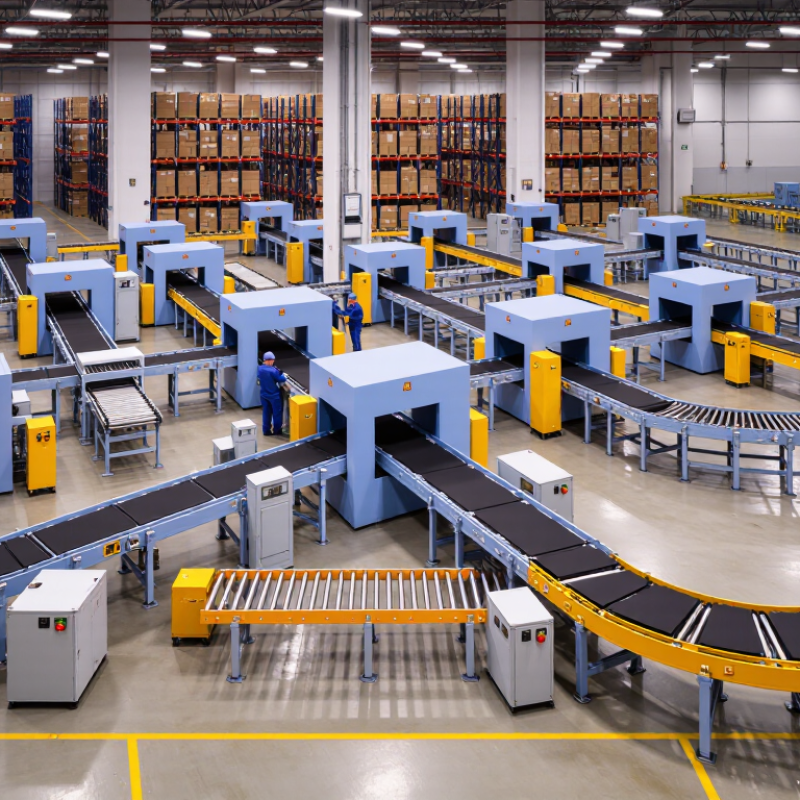
Belt conveyors move cartons, parcels, and bulk materials along steady routes. Roller systems suit flat-bottomed loads and can reduce manual handling at packing stations. Chain conveyors carry heavier items, such as pallets or metal parts, through demanding production areas. Modular plastic belts bend around curves and allow individual sections to be replaced. Small design choices matter. A damp washdown area needs different materials and joints from a dry parcel line.
When comparing suppliers, ask for load limits, belt speed, frame material, motor specifications, and maintenance access. Request a layout showing transfers and emergency stops. Ask how the system handles dust, water, or uneven product sizes. Fortune Business Insights’ market estimate does not reveal which conveyor type dominates Chinese installations, so avoid assuming one design fits every plant. That detail is easy to overlook. A short factory trial can expose transfer jams before installation.
Supplier Selection Metrics: ISO 5048, Load, Speed, and Safety Standards
Selecting a conveyor supplier is not just a price comparison. Ask for calculations tied to your material, route, and duty cycle. ISO 5048:1989 sets out methods for calculating operating power and belt tensile forces on belt conveyors with carrying idlers. A useful quotation should show the assumed belt width, incline, loading rate, and starting conditions. Check rated capacity and belt speed together: a faster belt may meet throughput targets but can increase spillage at transfer points. Small details matter. Ask how the supplier validates the figures under real operating conditions, not only at steady speed.
Safety and energy deserve equal scrutiny. Request a documented risk assessment, guarding details, emergency-stop arrangements, and maintenance access. ISO 12100 covers machinery risk assessment and risk reduction; ISO 13850 addresses emergency-stop functions. The U.S. Department of Energy’s 2014 motor-systems assessment estimated that motor-driven systems used about 68% of U.S. manufacturing electricity, making drive sizing and operating speed relevant to lifecycle costs. That figure is broad, not conveyor-specific. A supplier should therefore provide project-level motor and energy assumptions. One weakness in many comparisons: catalogue data can look precise while leaving the actual duty cycle unclear. Ask for test records and commissioning criteria, then check whether they match your site.
Top 10 Chinese Conveyor Suppliers: Company Profiles and Industry Applications
China’s conveyor supply base includes manufacturers focused on belt, roller, chain, and modular systems. Their capabilities vary: some build standard warehouse lines, while others engineer equipment for bulk materials or production plants. A useful supplier profile should describe design services, fabrication capacity, control integration, and after-sales support—not just product categories.
Applications shape the right choice. In parcel hubs, powered rollers can move cartons between scanning and sorting points. Food-processing lines may need washable belts and smooth frames that limit residue buildup. Mines and building-material sites often require heavy-duty belts, guarded transfer points, and dust-control measures. These are practical differences, not minor specifications. A mismatch in belt material or load rating can cause frequent stops. Small details matter.
When comparing suppliers, ask for drawings, load calculations, component specifications, and references for similar installations. Check whether the supplier can support commissioning and provide replacement parts locally. Factory visits can reveal how frames are welded and finished, though one visit cannot prove long-term reliability. I would also question polished project photos; they rarely show maintenance access or downtime records. The comparison may remain imperfect, but documented evidence makes it more useful.
China Conveyor Applications: 2023 Output Growth
Year-over-year growth in selected Chinese industries that commonly use conveyor systems.
Conveyor systems support bulk-material handling in sectors such as mining, steelmaking, cement production, and grain processing. These figures show industry output growth, not conveyor supplier rankings or market shares.
Sources: National Bureau of Statistics of China, 2023 Statistical Communiqué; National Bureau of Statistics releases on 2023 industrial production and grain output.
Technical Comparison: Belt Width, Drive Power, and Throughput up to 10,000 t/h
When comparing conveyor suppliers in China, headline capacity is only a starting point. A 10,000 t/h rating means 2.78 tonnes move every second. Belt width, speed, trough shape, and material density must work together to carry that load. CEMA’s Belt Conveyors for Bulk Materials, 7th edition, uses these factors in capacity assessment. A 2,000 mm belt running at 5 m/s may suit some high-capacity duties, but that figure alone proves little. Not a guarantee. Fine, dry material and damp, lumpy ore behave differently.
Drive power needs the same scrutiny. ISO 5048:1989 calculates conveyor power requirements by considering motion resistance, lift, and acceleration. So a short, level conveyor cannot be compared fairly with a long route climbing toward a stockpile. Ask suppliers to state belt width, operating speed, material density, route length, elevation change, and rated throughput under the same conditions. Request motor power and starting-load figures, too. A neat table can still mislead if it hides the assumptions. I would also check how the quoted capacity changes during wet-season operation; that detail is often less clear than it should be.