Leave Your Message
Choosing the right Conveyor Systems is not simply a matter of selecting the fastest belt or the lowest quoted price. It is a decision about product protection, workplace safety, available space, maintenance access, and future production needs. A dusty warehouse, a chilled food room, and a packaging line each demand different solutions. The wrong conveyor may create noise, product damage, bottlenecks, or expensive downtime.
Mike Gawinski, a conveyor systems specialist and materials-handling writer, offers a useful principle: “Design around the product, not the conveyor.” That advice deserves careful attention. A fragile carton may need gentle accumulation, while heavy pallets require stronger frames, controlled starts, and reliable braking. Operators also need clear access to emergency stops, transfer points, and cleaning areas. Small details matter.
A practical evaluation should examine load weight, dimensions, speed, incline, environment, and integration with scanners or robotic equipment. It should also consider how the system will be repaired after years of dust, impact, and daily use. Many buyers focus on capacity but overlook maintenance time. That is a costly blind spot.
No single conveyor fits every facility. Roller, belt, chain, screw, and overhead designs each solve different problems. The best choice may not look impressive. It may simply move products steadily, quietly, and safely. Even experienced teams can misjudge future demand, so modular expansion and honest testing should remain part of the plan.
How to Choose the Right Conveyor System?
Define Your Material Handling Requirements
Start with the material, not the conveyor design. Record each product’s weight, dimensions, shape, surface, and fragility. A cardboard carton behaves differently from a loose component or a sealed container. Include temperature, moisture, dust, and cleaning conditions. These details affect belt selection, frame materials, and drive protection.
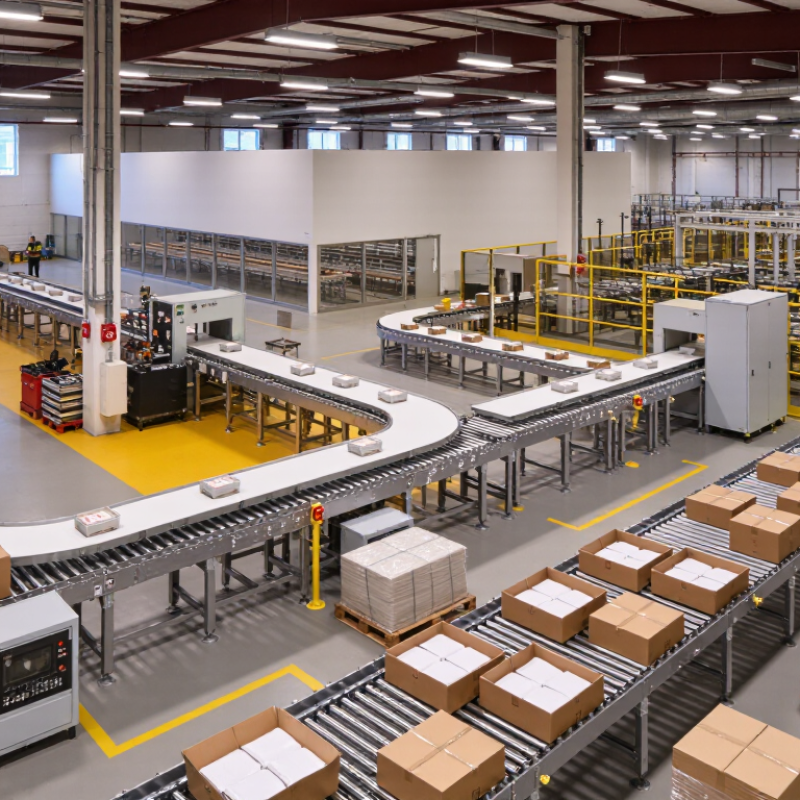
Measure the required throughput during normal and peak periods. Count units per minute and identify loading and discharge points. Note every transfer, incline, decline, and change in direction. A six-meter route with frequent stops may need different controls than a continuous line. Leave space for operators, inspections, and emergency access. Small gaps matter. They often become maintenance problems.
Consider how the system should respond to jams, product accumulation, and changing orders. Accumulation may protect upstream equipment, but it can also damage delicate goods. Ask whether operators will load products manually or use automated equipment. Check noise, cleaning, guarding, and workplace safety requirements. Local standards still need verification by qualified professionals.
Test representative products before approving the layout. Include the heaviest carton and the smallest item. Observe slipping, tipping, scratching, and unexpected gaps. Real facilities are rarely tidy. Dust collects. Products vary. A design that works on a quiet trial day may struggle during a busy shift. Document these weaknesses honestly, then revise the speed, spacing, controls, or access points before installation.
Compare common conveyor options against the key requirements of your application, including material characteristics, load, throughput, speed, incline, layout, and operating environment.
| Conveyor System | Typical Material & Load | Typical Throughput | Typical Speed | Incline Capability | Best-Fit Applications | Key Requirements | Main Limitations |
|---|---|---|---|---|---|---|---|
| Belt Conveyor |
Boxes, cartons, bags, parcels, food products, and bulk materials. Light to heavy loads, depending on belt width and construction. |
Approximately 50–2,000 tonnes per hour for bulk handling; lower rates are common for unit loads. | About 0.3–3.5 m/s for many industrial applications. | Usually up to 15–20° for packaged goods; lower angles may be required for loose bulk materials. | Long distances Bulk handling Sorting lines Incline transfer | Correct belt material, pulley sizing, tension control, guarding, and cleaning access. | Spillage and belt tracking can occur; sharp, hot, or abrasive materials may require specialized belts. |
| Gravity Roller Conveyor | Rigid-base cartons, totes, trays, and pallets with flat, stable bottoms. | Usually suited to low-to-medium flow rates and intermittent movement. | Product movement is controlled by gravity; speed depends on slope, load, and roller resistance. | Typically used on a controlled decline; level sections require manual pushing or external assistance. | Warehousing Accumulation Manual picking Loading areas | Consistent product dimensions, adequate slope, roller spacing, end stops, and operator safety controls. | Not suitable for soft-bottom products, very light items, irregular shapes, or precise speed control. |
| Powered Roller Conveyor | Cartons, totes, pallets, containers, and other unit loads with a stable base. | Medium-to-high flow rates; capacity depends on roller pitch, drive arrangement, and accumulation design. | Commonly about 0.1–1.0 m/s, with application-specific adjustment. | Generally limited for inclines unless designed with suitable drive power and product restraint. | Pallet handling Accumulation Packaging lines Distribution centers | Product weight and base dimensions must match roller pitch; zoned controls may be needed for accumulation. | Higher cost and energy use than gravity rollers; small or unstable products may require carriers. |
| Chain Conveyor | Heavy pallets, steel containers, rigid fixtures, and loads with a solid underside or defined support points. | Medium-to-high throughput for heavy unit loads; capacity is strongly dependent on chain and frame design. | Approximately 0.05–0.5 m/s in many heavy-duty applications. | Usually used horizontally; inclines require dedicated load-retention measures. | Heavy loads Pallet transfer Assembly lines Harsh environments | Defined load contact points, chain lubrication, guarding, robust frames, and suitable transfer devices. | Can be noisy; unsuitable for fragile or unstable products and may require regular chain maintenance. |
| Screw Conveyor | Powders, granules, pellets, sludge, and other bulk materials that can be conveyed in a trough or tube. | Approximately 5–500 m³/h, depending on screw diameter, pitch, fill level, and material properties. | Typically about 20–200 rpm; higher speeds may be used for selected materials and designs. | Horizontal conveying is most efficient; capacity generally decreases as the incline increases. | Powders Granules Controlled feeding Enclosed transfer | Material flowability, moisture content, abrasiveness, temperature, screw fill, and seal selection. | May damage fragile materials; wear and power demand increase with abrasive products or steep inclines. |
| Bucket Elevator | Dry bulk materials such as grain, pellets, powders, and free-flowing granules. | Approximately 10–1,000 m³/h, depending on bucket size, spacing, speed, and material density. | Bucket speed is commonly selected within a range suitable for the material and discharge method. | Designed for near-vertical lifting rather than horizontal conveying. | Vertical lifting Bulk storage Process plants Limited floor space | Material moisture, dust control, bucket fill, belt or chain selection, inspection access, and safety devices. | Not ideal for sticky or highly fragile materials; dust, wear, and misalignment require careful management. |
| Pneumatic Conveyor | Dry powders, fine granules, pellets, and lightweight bulk materials. | Commonly about 1–100 tonnes per hour, depending on conveying mode, distance, and material properties. | Air velocity often ranges from approximately 15–30 m/s, depending on the material and system design. | Well suited to complex routes, including vertical and horizontal sections. | Enclosed transfer Dust-sensitive areas Multiple destinations Complex layouts | Particle size, bulk density, moisture, air-to-solid ratio, filtration, pressure loss, and explosion protection. | Higher energy consumption; abrasion, product degradation, and filter maintenance may be significant. |
| Overhead Conveyor | Hanging garments, components, tools, parts, and products supported by carriers or hooks. | Determined by carrier spacing, line speed, product weight, and process cycle time. | Often about 0.05–0.5 m/s, depending on the process and load type. | Can incorporate vertical rises and declines with suitable carrier and drive design. | Painting lines Assembly Garment handling Floor-space saving | Carrier design, suspended-load stability, overhead clearance, access platforms, and emergency stops. | Installation and maintenance may require elevated access; load balance and clearance are critical. |