Leave Your Message

What Are the Top Conveyor Equipment Suppliers in China?

China’s manufacturing and logistics sectors rely on conveyors to move materials steadily between production lines, warehouses, and loading bays. A belt conveyor carrying cartons through a distribution center may look simple, but its motors, controls, rollers, and safety features affect uptime and operating costs. Conveyor Equipment buyers therefore need more than a supplier name. They need evidence of capacity, service, and fit for the job.

Market reports show why supplier selection deserves care. Grand View Research estimated the global conveyor system market at about US$10.6 billion in 2023 and projected continued growth through 2030. The International Federation of Robotics reported that China installed 276,288 industrial robots in 2023, roughly 51% of global installations. Robot installations are not conveyor sales, of course. They do, however, reflect the scale of automation investment around which material-handling systems often operate.

This guide examines prominent conveyor equipment suppliers in China and the differences buyers should verify. These include product range, customization, documented quality systems, export experience, and after-sales support. A polished product page is not proof of dependable delivery. Ask for technical drawings, load ratings, component specifications, and references for similar applications. Small details matter: belt width, incline angle, washdown needs, and spare-parts lead time can change the real cost of ownership. No single supplier is best for every facility. The right choice depends on the material, layout, duty cycle, and support available after installation. Some comparisons remain imperfect, because public supplier data is uneven. That is worth keeping in mind.
What Are the Top Conveyor Equipment Suppliers in China?

Understanding China’s Conveyor Equipment Supply Industry

China’s conveyor equipment supply industry is shaped by manufacturing scale and fast-changing logistics needs. The National Bureau of Statistics reported that manufacturing value added grew 5.0% in 2023. That growth supports demand for belt, roller, and modular systems in factories and distribution centers. The China Federation of Logistics and Purchasing reported total social logistics costs of 18.2 trillion yuan that year, while total logistics value reached 352.4 trillion yuan. These figures indicate a large operating environment, not a guaranteed market for every supplier.

Suppliers commonly provide more than frames and motors. Buyers may need layout design, controls integration, installation, spare parts, and service response. A practical assessment checks belt material, load capacity, incline, washdown needs, and access to replacement rollers. Small details matter. A poorly placed transfer point can cause jams or product damage. China’s broad manufacturing base can support varied component sourcing, but quality and lead times still differ between factories. Reports on logistics spending do not measure conveyor sales directly; that distinction is easy to overlook. Buyers should therefore verify test records, component specifications, and maintenance arrangements against the actual site, rather than relying on catalog capacity alone.
Key Types of Conveyor Equipment Made in China

Key Types of Conveyor Equipment Made in China

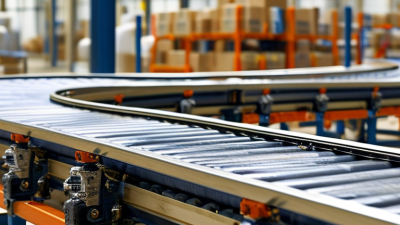
Chinese manufacturers produce belt, roller, chain, screw, and vertical conveyor systems for different materials and plant layouts. Belt conveyors move cartons, bags, and bulk goods across long, level routes; their tracking and belt tension need regular checks. Roller conveyors suit rigid boxes and pallets, while powered rollers help control spacing near sortation points. Chain and slat systems handle heavier loads, such as assembled components. Screw conveyors move powders or granules through enclosed troughs, but abrasive materials can wear the flights quickly. Vertical conveyors save floor space between levels. They also add transfer points, which deserve careful guarding and maintenance.

These systems increasingly sit beside automated equipment. The International Federation of Robotics reported 276,288 industrial robot installations in China in 2023, representing 51% of global installations in its World Robotics 2024 report. This figure is not conveyor-market data, but it shows the scale of automation that conveyors may need to feed. In practice, selecting equipment depends on load, travel distance, dust, washdown needs, and required throughput. A fast line is not always a reliable line. I have seen layout assumptions look tidy on paper, then falter when operators need room to clear a jam. That detail is easy to underestimate.

How to Assess Conveyor Equipment Suppliers

Assessing conveyor equipment suppliers in China starts with a clear duty cycle, not a catalog. Specify load, belt speed, operating hours, incline, and the environment around the line. Ask for drawings, motor data, component specifications, and documented test results. Ask for proof. A supplier should explain how its design handles belt tracking, emergency stops, and routine maintenance. Vague answers deserve follow-up.

MHI’s 2024 Annual Industry Report, produced with Deloitte, found that 88% of surveyed supply-chain professionals expected to increase technology investment over the following five years. That trend makes integration worth checking: request interface details and confirm the conveyor can communicate with existing controls. Then compare suppliers using the same written specification. A low quote can hide thinner belt material, limited spare-parts support, or unclear commissioning costs. Still, a polished presentation is not evidence of factory capability.

Where possible, inspect a comparable operating line or arrange a witnessed acceptance test. Watch a loaded conveyor run; listen for unusual vibration and check whether the belt drifts. Review inspection records, production capacity, lead times, packing methods, and after-sales response procedures. Confirm who handles installation guidance and which parts are stocked locally. One test is only a snapshot. I would also ask for a corrective-action example; it reveals how the supplier responds when a real defect appears.

What Are the Top Conveyor Equipment Suppliers in China? — How to Assess Conveyor Equipment Suppliers
Assessment Dimension Weight What to Assess Evidence to Request Score (1–5)
Application and engineering fit 20% Ability to size and configure the conveyor for the material, throughput, route, environment, and operating conditions. Application questionnaire, layout drawings, capacity calculations, and a written scope of supply. _____
Product range and configuration 12% Availability of suitable conveyor types and options, such as belt, roller, chain, or screw systems, where appropriate to the application. Product specifications, component list, configuration drawings, and details of any outsourced items. _____
Build quality and quality control 15% Documented inspection processes, traceability where applicable, and consistent checks of fabrication, assembly, and purchased components. Quality procedures, inspection records, material certificates where relevant, and a sample inspection or factory audit. _____
Safety and compliance 12% Whether the design addresses relevant guarding, emergency stops, electrical safety, and the regulations applicable in the destination market. Risk assessment, safety-device list, electrical documentation, and applicable conformity documentation. Verify certificates and their scope independently. _____
Testing and commissioning 10% Defined inspection, factory testing, installation support, commissioning, and acceptance criteria. Factory acceptance test plan, test records, commissioning scope, and agreed performance criteria. _____
Delivery and project management 10% Clarity of the project schedule, design approvals, production milestones, packing, shipping responsibilities, and communication. Project timeline, milestone plan, packaging specification, and written delivery terms. _____
After-sales service and spare parts 10% Availability of technical support, troubleshooting, replacement parts, and service arrangements for the intended operating region. Service response terms, spare-parts list, parts lead times, and support contact process. _____
Commercial clarity and total cost 6% Transparency of included equipment, exclusions, payment terms, warranty conditions, and costs beyond the purchase price. Itemized quotation, warranty terms, exclusions list, and applicable shipping, installation, and maintenance costs. _____
Total weighted score 100% Calculate each score as (rating ÷ 5) × its weight, then add the weighted results. Compare suppliers only after confirming that each quotation covers a comparable scope. _____ / 100

Rating guide: 1 = weak or unsupported; 2 = below requirements; 3 = meets stated requirements; 4 = strong, well-documented capability; 5 = excellent, independently verifiable capability. This is a supplier-neutral assessment framework, not a ranking of specific companies.

Profiles of Leading Conveyor Equipment Suppliers in China

China’s conveyor equipment suppliers vary more by engineering focus than by product name. Some operate large fabrication facilities and produce belt conveyors, rollers, frames, and transfer points in-house. Their strength is component control. Buyers should still ask for material specifications, weld inspection records, and load-test results. Details matter.

Other suppliers specialize in modular systems for warehouses and light manufacturing. Their profiles often include roller, belt, and accumulation conveyors, with controls adapted to changing product flows. Ask how they handle irregular cartons, stop-start operation, and maintenance access. A polished layout drawing is useful, but it does not prove that the line will run smoothly under peak loads.

Heavy-duty suppliers tend to serve mining, ports, and bulk-material sites. Their experience may include long runs, high-capacity belts, dust protection, and weather-resistant structures. Request references for comparable operating conditions, not merely similar equipment. Site visits can reveal practical details, such as guarding, inspection platforms, and spare-part storage. Supplier information is not always equally detailed, and that can make comparisons frustrating. Treat missing test data as a question to resolve, not a reason to assume poor quality. A credible profile should explain design limits, service coverage, commissioning support, and how performance claims are measured.

Conveyor Equipment Suppliers in China: Standard Belt Widths

Common nominal belt widths used in conveyor specifications, shown in millimeters. This product-specification benchmark provides context for comparing supplier capabilities; it is not a company ranking or a claim about any individual supplier’s catalog.

Available widths and permissible tolerances depend on the belt standard and project requirements. Confirm specifications directly with suppliers.

Factors Shaping China’s Conveyor Equipment Market

China’s conveyor equipment market is being shaped by rising automation needs, expanding logistics networks, and pressure to move goods faster. The International Federation of Robotics’ World Robotics 2024 report recorded 276,288 industrial robot installations in China in 2023, about 51% of the global total. More automated production lines need conveyors that connect robots, inspection stations, and packing areas. Small design details matter: a transfer point that leaves a gap can disrupt the whole line.

Logistics growth adds another driver. The China Federation of Logistics and Purchasing reported that China’s total social logistics value reached 360.6 trillion yuan in 2024, up 5.8% year on year. Warehouses handling cartons, parcels, and mixed-size loads need flexible belts, rollers, and sorting systems. Reliability counts. A stopped conveyor can leave workers waiting beside a growing queue of parcels.

Energy use, labor availability, and factory space also shape purchasing decisions. Buyers increasingly compare throughput with maintenance access, noise, and power consumption—not just purchase price. Yet automation is not a cure-all. This is easy to overstate. Poor layout, dusty environments, or inconsistent package sizes can still cause jams. Suppliers that understand site conditions can specify more practical systems, though performance claims should be checked against real operating data.