2026 Top Automation Conveyors for Global Buyers
Choosing the right Automation Conveyors in 2026 requires more than comparing catalog prices or advertised speeds. Global buyers must examine product performance, supplier reliability, integration support, and long-term operating costs. A conveyor that moves 60 cartons per minute in a showroom may perform differently beside a dusty loading dock.
This guide reviews leading conveyor solutions for distribution centers, warehouses, manufacturing plants, and e-commerce operations. It considers belt, roller, modular, chain, and flexible conveyor designs. Key factors include load weight, belt width, incline angle, motor efficiency, noise levels, sensor accuracy, and maintenance access. A 600-millimeter belt may suit standard cartons, while heavier pallets often require stronger frames and drive systems. Small details matter.
Not every “top” model fits every facility. That is easy to forget. Buyers should verify throughput using real carton sizes, shift patterns, and ambient conditions. Supplier documentation should include drawings, safety information, warranty terms, spare-parts availability, and commissioning support. Compatibility with warehouse management systems and existing controls also deserves careful review.
Electrical requirements and product certifications vary by destination market. Buyers should confirm applicable regional standards with qualified engineers and local compliance teams. This comparison aims to support informed decisions, not replace site testing or professional risk assessments. Some performance claims may look impressive, yet practical reliability often depends on installation quality and operator training. The best choice is usually the conveyor system that remains stable, serviceable, and adaptable after daily use begins.
2026 Conveyor Taxonomy: Belt, Roller, Chain, and AMR-Linked Systems
2026 Top Automation Conveyors for Global Buyers
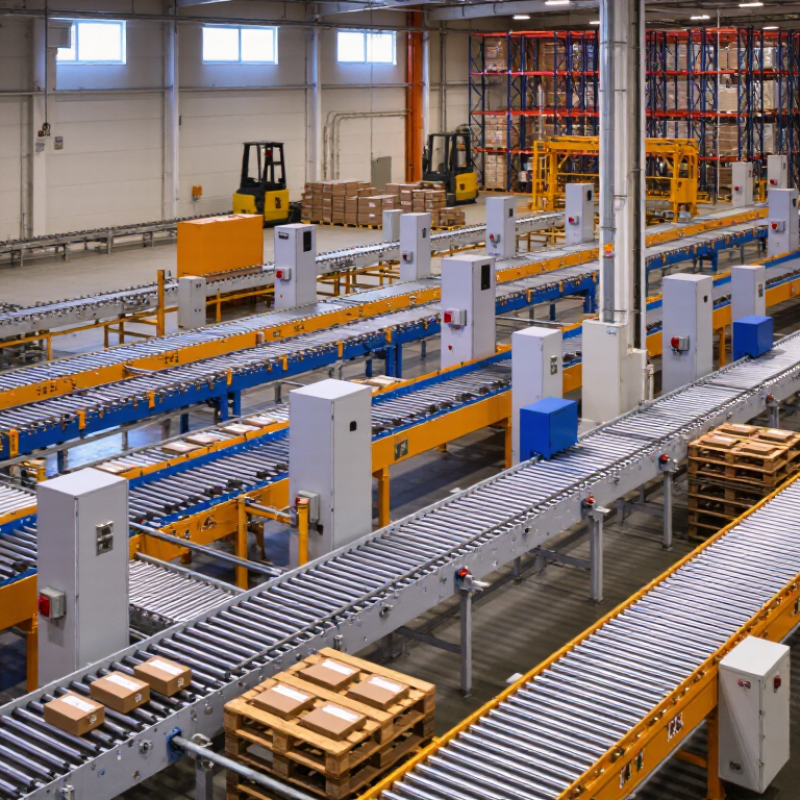
The 2026 conveyor taxonomy starts with the product, not the motor.
Belt conveyors suit cartons, bags, and irregular loads. Their continuous surface reduces product gaps and protects small packages.
Roller conveyors handle rigid cartons and pallets, especially where accumulation is required. Powered zones can stop one load while another continues moving.
Chain conveyors carry heavy pallets through manufacturing and distribution environments. They tolerate harsh conditions, but poor lubrication can increase noise and downtime.
AMR-linked systems add mobile flexibility. Conveyors provide stable transfer points, while autonomous mobile robots manage variable routes. This hybrid model can reduce fixed infrastructure, although software integration remains a practical weakness.
MHI’s 2024 Annual Industry Report found that
55%
of surveyed supply-chain professionals expected to increase technology investment within two years. The report supports stronger automation demand, but it does not measure conveyor purchases alone. IFR’s
World Robotics 2024 report recorded
541,302
industrial robot installations in 2023. That figure shows broader automation momentum, not direct conveyor growth. Buyers should therefore compare throughput, load weight, noise, washdown needs, and emergency-stop access. They should also verify AMR traffic rules against applicable safety standards. A technically impressive layout can still fail under real congestion. Pilot testing with mixed cartons is often wiser than trusting clean simulation data.
Market Evidence: MHI 2024 Automation Investment and Labor-Shortage Data
2026 Top Automation Conveyors for Global Buyers
Market Evidence: MHI 2024 Automation Investment and Labor-Shortage Data
MHI’s 2024 industry research shows that workforce shortages remain a serious supply-chain pressure. Many companies are increasing investment in automation and digital tools. This shift gives automated conveyors a practical role in 2026 purchasing decisions.
For global buyers, the best system is not always the fastest one. A warehouse handling cartons may need variable-speed belts, accurate sensors, and simple controls. A facility moving heavy pallets needs stronger frames, safer stopping systems, and easier maintenance access. Labor shortages also increase the value of automatic sorting, accumulation, and transfer functions.
Small details matter. Check local electrical standards, spare-part availability, noise levels, and operator training requirements. Ask suppliers for tested load data, not only attractive throughput claims. MHI’s findings support continued technology investment, but budgets still require discipline. Automation can reduce repetitive work, yet poor layout design may create new bottlenecks.
The evidence is useful, not perfect. Survey intentions do not guarantee successful installation. Some buyers may over-automate before measuring daily volume, package variation, and peak-season demand. A reliable conveyor plan should include manual bypass points, clear guarding, and realistic maintenance time. That is less impressive on paper. It is often more dependable in operation.
Capacity Sizing: CEMA 7th Edition Throughput, Speed, and Load Calculations
Sizing an automation conveyor starts with throughput, not motor selection. CEMA 7th Edition tables connect belt width, speed, trough angle, material density, and surcharge angle. The basic relationship is practical: capacity rises with belt speed and loaded cross-sectional area. It also falls when material loading becomes inconsistent.
For example, a 36-inch belt moving at 400 feet per minute may handle several hundred short tons per hour. The exact result depends on bulk density and the usable area shown in CEMA tables. A 50 lb/ft³ material behaves differently from a damp 90 lb/ft³ product. Designers should calculate capacity using Q = 60A×V×ρ/2,000, then apply a realistic loading factor. Do not size directly from the theoretical maximum.
A conveyor rated for 500 tons per hour may experience surges, spillage, or uneven feeding. Real installations are less tidy. MHI’s 2024 Annual Industry Report found that 55% of supply chain leaders expected to adopt artificial intelligence within five years. That pressure encourages automation, but better data still matters more than fashionable controls. A clean spreadsheet can hide poor density measurements.
Tips: Record actual feed rates during peak shifts. Check belt speed with a calibrated instrument. Verify bulk density from several samples, not one bucket. Allow room for future demand, but avoid oversized equipment that wastes energy and floor space. Recheck calculations when moisture or particle size changes.
2026 Top Automation Conveyors for Global Buyers - Capacity Sizing: CEMA 7th Edition Throughput, Speed, and Load Calculations
Reference sizing matrix for troughed belt conveyors. The calculated capacity uses the mass-flow relationship
Q = 3.6 × ρ × A × v, where Q is capacity in t/h, ρ is bulk density in kg/m³, A is the effective loaded cross-sectional area in m², and v is belt speed in m/s.
| Application Duty |
Bulk Material |
Bulk Density
(kg/m³) |
Belt Width
(in) |
Trough Angle
(°) |
Belt Speed
(m/s) |
Effective Loaded Area
(m²) |
Calculated Throughput
(t/h) |
Planning Target
at 85% (t/h) |
Material Load
(kg/m) |
Sizing and Operating Consideration |
| Primary Crushing Transfer |
Limestone |
1,600 |
24 |
35 |
0.45 |
0.050 |
129.6 |
110.2 |
72.0 |
Use impact-resistant loading zones, robust skirt sealing, and a controlled feed profile. |
| Aggregate Reclaim |
Crushed stone |
1,550 |
30 |
35 |
0.60 |
0.075 |
251.1 |
213.4 |
116.3 |
Allow for abrasion, lump size, loading-zone impact, and belt-cleaning requirements. |
| Fuel Handling |
Bituminous coal |
800 |
36 |
35 |
0.75 |
0.120 |
259.2 |
220.3 |
96.0 |
Use dust-control measures, fire-risk monitoring, and guarding suitable for combustible dust. |
| Biomass Transfer |
Wood chips |
250 |
36 |
35 |
0.90 |
0.200 |
162.0 |
137.7 |
50.0 |
Check material bridging, moisture variation, dust emissions, and the required hopper geometry. |
| Grain Receiving |
Wheat or similar grain |
750 |
24 |
35 |
0.60 |
0.090 |
145.8 |
123.9 |
67.5 |
Prioritize sanitary access, low-damage transfer points, dust extraction, and cleanability. |
| Ore Stockyard Transfer |
Crushed iron ore |
2,200 |
36 |
45 |
0.90 |
0.160 |
1,140.5 |
969.4 |
352.0 |
Verify belt tension, idler load, pulley selection, starting torque, and structural deflection. |
| Cement Plant Feed |
Clinker |
1,300 |
30 |
35 |
0.50 |
0.065 |
152.1 |
129.3 |
84.5 |
Account for elevated temperature, abrasive particles, sealing, and maintenance access. |
| Fertilizer Handling |
Granular fertilizer |
1,050 |
24 |
35 |
0.50 |
0.060 |
113.4 |
96.4 |
63.0 |
Control moisture exposure and corrosion; confirm compatibility of belt covers and chute liners. |
|
Calculation basis: Material load per metre is calculated as M = ρ × A.
Planning target equals 85% of calculated theoretical throughput and is a conservative operating allowance,
not a mandatory CEMA factor. Final selection should be checked against CEMA 7th Edition capacity tables,
surcharge angle, material lump size, idler configuration, belt limits, loading conditions, take-up travel,
conveyor inclination, and applicable local safety requirements.
|
Engineering note: Bulk density, effective loaded area, and material behavior can vary substantially
with moisture, particle-size distribution, segregation, and loading method. The values shown are representative
engineering design inputs for preliminary comparison and should be replaced with project-specific test data before
procurement or final equipment release.
Control Architecture: PLCs, OPC UA, IEC 61131-3, and Industry 4.0 Integration
2026 Top Automation Conveyors for Global Buyers
Control architecture now separates capable conveyor systems from expensive moving equipment. A PLC executes IEC 61131-3 logic for zones, merges, sensors, and emergency stops. Engineers can document function blocks clearly, even when maintenance teams change shifts or locations. Keep critical interlocks local. Cloud dashboards should not control every motor.
OPC UA provides structured data for speed, alarms, energy use, and fault history. A pallet conveyor can publish “zone occupied” or “motor temperature” without exposing proprietary control logic. This supports safer integration with manufacturing execution and warehouse systems. The International Federation of Robotics reported 541,302 industrial robots installed globally in 2023, showing why conveyor controls need scalable coordination (World Robotics 2024). The Deloitte 2024 Smart Manufacturing and Operations Survey found that 86% of executives expect smart manufacturing to become a major competitiveness driver within three years.
Data alone changes nothing.
For global buyers, request an IEC 61131-3 software standard, an OPC UA information model, role-based access, and time-stamped diagnostics. Test network recovery with a loaded conveyor, not an empty demonstration line. Industry 4.0 integration also needs clean naming, version control, and documented cybersecurity responsibilities. Some suppliers still promise plug-and-play integration too casually. It rarely stays simple after legacy sensors, mixed protocols, and imperfect production data appear. A practical architecture leaves room for manual operation, local troubleshooting, and gradual expansion.
Global Compliance: ISO 13849-1, IEC 60204-1, OSHA 1910.212, and CE Marking
For global buyers, conveyor automation is not only a throughput decision. It is a documented safety decision. ISO 13849-1 guides the design and validation of safety-related control systems. Engineers assess risks, required performance levels, and fault behavior before selecting sensors or emergency stops. A guarded transfer point should stop quickly when a gate opens. That response must be tested, recorded, and repeatable.
IEC 60204-1 addresses the electrical equipment of machinery, including wiring, protective bonding, control circuits, and emergency-stop functions. OSHA 1910.212 requires suitable machine guarding in United States workplaces. Guards should prevent hands from reaching nip points, rotating parts, and moving belts. CE marking shows that the manufacturer declares conformity with applicable European requirements. It is not a universal approval stamp. Local installation rules still matter.
Experienced project teams review safety circuits during factory acceptance testing, not after shipment. They inspect cable routing, access doors, reset locations, warning labels, and lockout provisions. Technical files should include risk assessments, schematics, validation records, and operating instructions. Small gaps appear often. A sensor may work perfectly in a clean test area but fail under dust, vibration, or poor alignment. We have seen teams trust checklists too much. Periodic testing and operator feedback can reveal risks that design reviews miss. Controls should be practical, visible, and easy to maintain.
2026 Top Automation Conveyors for Global Buyers
Global Compliance Coverage: ISO 13849-1, IEC 60204-1, OSHA 1910.212, and CE Marking
This chart maps the primary compliance areas addressed by each framework. A value of 1 means the topic is directly addressed; 0 means it is not the framework’s primary subject. ISO 13849-1 focuses on safety-related control systems, IEC 60204-1 on the electrical equipment of machines, OSHA 1910.212 on machine guarding in the United States, and CE marking on applicable European conformity obligations. Actual conveyor compliance depends on the machine design, risk assessment, destination market, and applicable legislation.
References: ISO 13849-1:2023; IEC 60204-1:2016+A1:2021; OSHA 29 CFR 1910.212; European Commission guidance on CE marking and machinery conformity assessment.